Footer Image
Arrow
Arrow

Specialist Teams

Capabilities

Specialist Teams

Capabilities

Specialist Teams

Capabilities

Specialist Teams

Capabilities

Specialist Teams

Capabilities

Specialist Teams

Capabilities

Specialist Teams

Capabilities

Specialist Teams

Capabilities

Managed Operations

Run and improve, with one accountable team

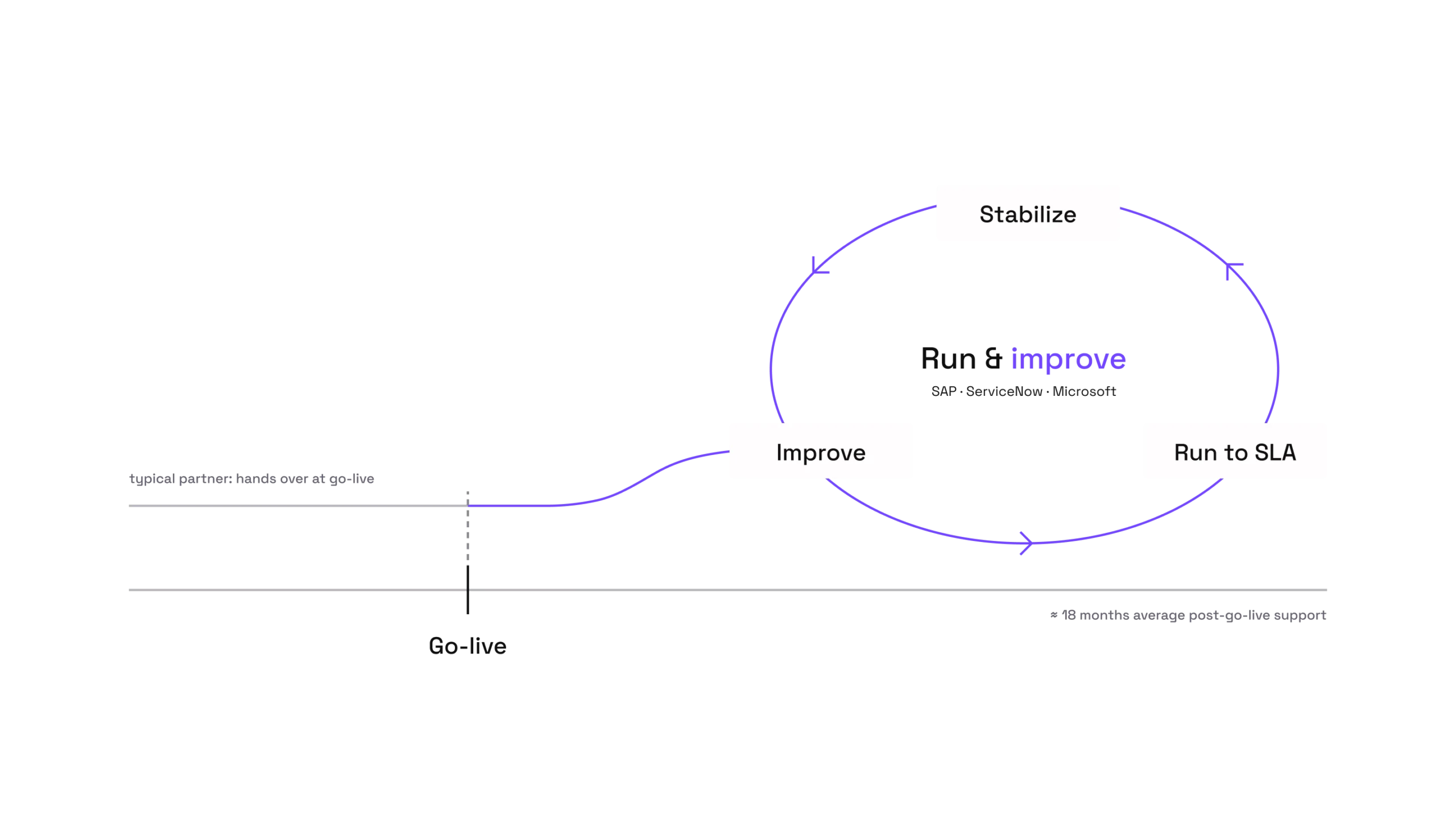
You are accountable long after go-live, when most partners have already moved on. We stay: stabilizing, running to clear SLAs, and improving against the baseline we set at design, across SAP, ServiceNow and Microsoft. The team that advised and built is the team that runs it.
Run and Improve lifecycle diagram showing post-go-live support stages for SAP, ServiceNow, and Microsoft solutions

Delivered by

|

evora asset logo
evora services logo
evora connect logo
all4cloud core logo

Trusted by

The challenge

Why do AI and automation stall as pilots?

Go-live gets treated as the finish line. The team that knew the decisions hands over to one that does not, and the context is lost. Support turns into ticket-closing rather than improvement. And the KPIs agreed at design quietly stop being measured, so the solution drifts from what it was built to do.

The result: a system that degrades instead of compounding, and an outcome no one is clearly accountable for.

The Transformation

What changes with Evora?

Industrial machine with digital analytics overlay for predictive maintenance and asset performance
Industrial field engineer wearing a hard hat and holding a tablet for digital maintenance

How Evora delivers

How managed operations works

1

Stabilize
We carry the context from build into run, fix what surfaces under real load, and bring the solution to steady, measured performance.

2

Run to SLAs
We operate the solution to clear service levels with named ownership: application management across SAP, ServiceNow and Microsoft, governed and transparent.

3

Improve continuously
We measure against the baseline agreed at design, find what to improve next, and keep the solution compounding in value. Across the group, post-go-live support averages about 18 months; we stay available.

What we do

We run your applications day to day so they stay healthy and current: incidents, requests, changes, releases and the small fixes that keep a system fit. Because one team covers SAP, ServiceNow and Microsoft, you get a coherent operation rather than three disconnected support contracts that each blame the others. Your internal team is freed from keeping the lights on and can focus on the work that actually moves the business, while the platforms stay reliable underneath them.

We operate to clear service levels with named ownership, so you always know what “good” means and who is accountable for it. SLAs, priorities and escalation are defined and reported, not improvised when something breaks. You get predictable service and a single point of accountability, which is the difference between a vendor you have to manage and a partner who manages the operation for you and tells you honestly how it is performing.

We carry the knowledge from the build straight into run, so the riskiest period, the weeks just after go-live, is handled by people who know exactly what was built and why. We catch and fix what only shows up under real load and bring the solution to steady performance fast. You avoid the all-too-common dip where an unfamiliar support team slowly relearns the system while users lose confidence and old workarounds creep back in.

We keep measuring the KPIs you agreed at design, so run performance ties back to the outcomes the project promised, not just to ticket counts. If the solution starts drifting from its targets, you see it and we act. This is what stops the slow erosion that turns a successful go-live into a tired system two years later, and it keeps the conversation about value rather than only about availability.

We treat run as the place where value is still being created, not just protected. On a regular cycle we bring you a prioritized list of improvements, drawn from how the system is actually used and where the friction is, and we deliver them. The solution keeps getting better instead of standing still, your investment compounds, and the roadmap is driven by evidence from operations rather than by whoever has the loudest request this quarter.

Whatever the mix of SAP, ServiceNow and Microsoft, and wherever you operate, you deal with one accountable team rather than a patchwork of suppliers. Across more than 900 go-lives, that continuity is the whole point: the people who advised and built stay to run it, so context is never handed off and lost. You get a single team that genuinely owns the outcome, end to end, long after the project that created it has closed.


Case Studies

Proof of execution.

Globus logo in white

Magazine zum Globus AG

Read how Evora supported Globus AG in turning complex operational requirements into governed, reliable execution across systems and daily operations.

Professional headshot of Giovanni Odoni in a black suit and white shirt

“Our collaboration with our colleagues at Allgeier was constructive and always characterized by a positive attitude.”

Giovanni Odoni
– Director IT Business Solutions

95

IT services migrated into the new operating environment.

In 18 months

months full IT independence under high time pressure was achieved.

What was involved

The project involved M365, Azure Cloud, Active Directory migration, tenant cutover, DNS, and selected network services.

95

IT services migrated into the new operating environment.

In 18 months

months full IT independence under high time pressure was achieved.

What was involved

The project involved M365, Azure Cloud, Active Directory migration, tenant cutover, DNS, and selected network services.

Speak with an expert

Define the operating model your teams can actually run.

Tell us where execution stalls, which outcomes matter, and which systems need to connect. We will route your request to the right Evora expert.

Abstract purple wave background for modern technology and digital transformation design

Sales Americas

Abstract purple wave background for modern technology and digital transformation design

Sales EMEA

Abstract purple wave background for modern technology and digital transformation design

Sales APAC

Request a meeting

Tell us your challenge — right expert within 24h.

GDPR compliant. Data never shared.

Request a meeting

Tell us your challenge — right expert within 24h.

GDPR compliant. Data never shared.

FAQ

Questions enterprise leaders ask before they commit.

Running and improving enterprise systems after go-live, stabilization, SLA-governed run and continuous improvement, not just incident-closing support.
Standard support closes tickets. Managed operations is accountable for outcomes: it measures against the design baseline and keeps improving the solution.
Yes, and that is the point. The team that advised and built stays to run it, so context and accountability are never handed off and lost.
SAP, ServiceNow and Microsoft landscapes, under one accountable operating model rather than separate, disconnected support contracts.
Across the group, post-go-live support averages about 18 months, structured around stabilization and continuous improvement.
To clear SLAs with named ownership, and measured against the KPI baseline agreed at design, so run performance ties back to the outcomes you committed to.

More Questions?